


Introduction
Knee arthritis does not always lead to surgery. For many patients, especially those in the early to moderate stages, PRP injection for the knee has become a practical and effective way to manage pain, reduce inflammation, and slow down joint degeneration – without going under the knife.
At Dr. Sudhir Kapoor’s orthopaedic centre in Pitampura, New Delhi, PRP therapy has been used for years as part of a broader approach to biological and regenerative treatment. This post explains how the treatment works, what the process looks like, who it is suitable for, and what factors typically influence the cost of PRP injections for the knee in India.
Understanding PRP Therapy for Knee Arthritis

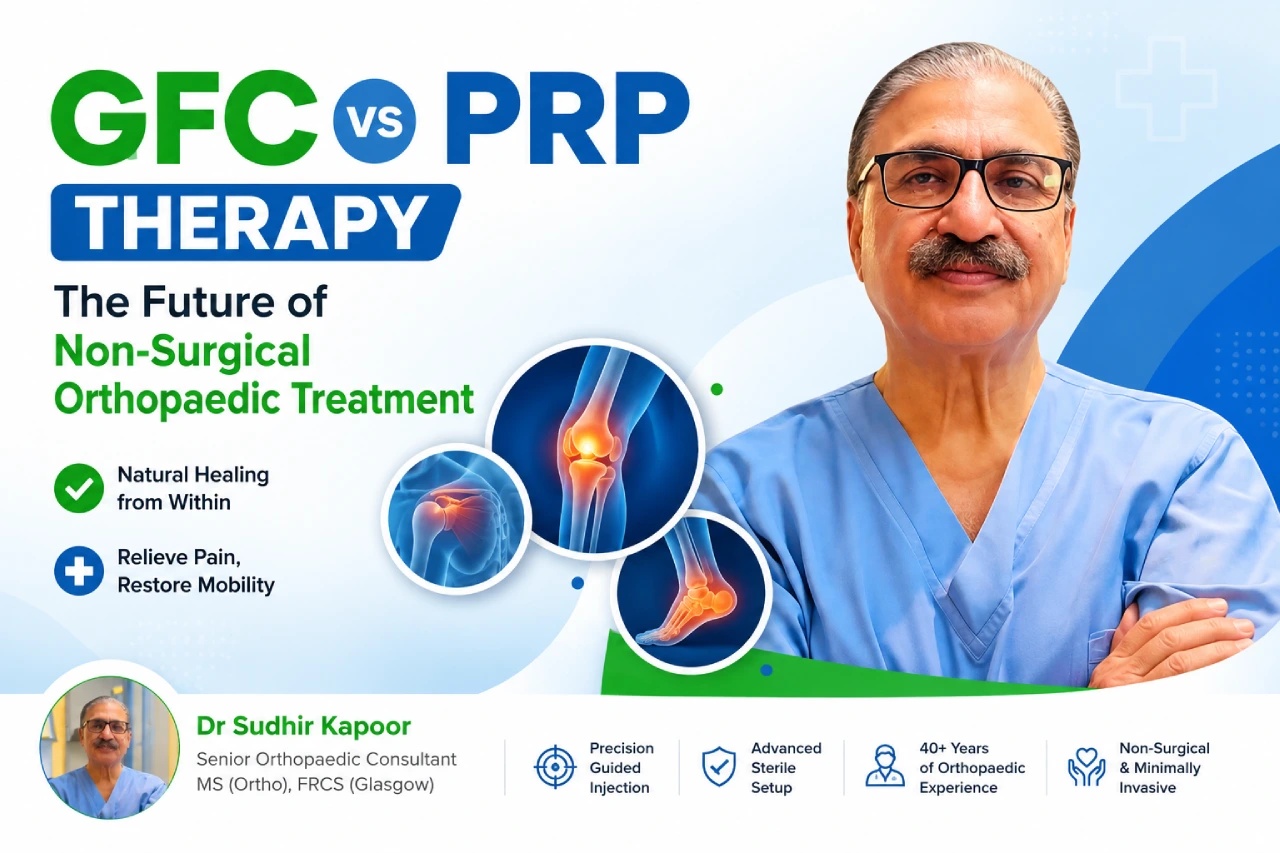
Platelet-Rich Plasma (PRP) therapy is a regenerative treatment that uses a patient’s own blood to promote healing and reduce inflammation in the affected knee joint. The process involves:
- Drawing a small amount of blood from the patient.
- Spinning the blood in a centrifuge to separate the platelets, which are rich in growth factors.
- Injecting the concentrated platelet solution into the knee joint.
How PRP Helps in Knee Arthritis:
- Stimulates tissue repair and cartilage regeneration.
- Reduces inflammation and pain.
- Improves joint function over time
Now a days, there is available a technique, where the growth factor concentrate from the platelets is directly prepared and injected into the arthritic knee, instead of platelet concentrate.
What Does the PRP Injection Procedure Actually Involve?
Many patients come in having read about PRP online but are unsure what to expect on the day. Here is a straightforward breakdown:
A small amount of blood is drawn from your arm, similar to a routine blood test. The sample is then placed in a centrifuge, which spins it at high speed to separate the platelets from the rest of the blood components. The resulting platelet-rich plasma is then carefully injected into the affected knee joint.
The entire process typically takes between 45 minutes to an hour. There is no general anaesthesia, no hospital admission, and most patients are able to go home the same day. Some mild soreness around the injection site is normal for a day or two.
At our centre, injections are administered under C-Arm image guidance to ensure the platelet concentrate reaches the exact area within the joint that needs it. This is an important detail – an accurate injection significantly improves the chance of a good outcome.
Other Advanced Biological Treatments for Knee Arthritis
- Stem Cell Therapy
Stem cells are harvested from the patient’s bone marrow or adipose tissue and injected into the arthritic knee to repair damaged cartilage and reduce inflammation.- Benefits: Long-term pain relief, improved mobility, and reduced need for surgery.
- Hyaluronic Acid Injections
These injections supplement the natural fluid in the knee, providing cushioning and lubrication to reduce pain and improve movement.- Ideal for: Patients with mild to moderate arthritis.
- Prolotherapy
This involves injecting an irritant solution into the knee joint to stimulate the body’s healing response and strengthen weakened tissues.- Benefits: Improved joint stability and reduced pain.
- Autologous Conditioned Serum (ACS)
ACS, also known as Orthokine therapy, uses the patient’s own blood to create a serum rich in anti-inflammatory cytokines, which is injected into the joint.- Benefits: Significant reduction in inflammation and pain.
Advantages of Biological Treatments for Knee Arthritis
- Non-Surgical: These therapies provide effective solutions without the need for invasive procedures.
- Natural Healing: They use the body’s own resources to promote regeneration and reduce pain.
- Minimal Downtime: Patients can typically resume normal activities shortly after treatment.
- Long-Lasting Relief: Many patients experience sustained improvements in pain and mobility.
Why Choose Advanced Solutions in India?
India has become a hub for advanced orthopaedic treatments, offering world-class care at affordable costs. Specialists like Dr. Sudhir Kapoor, based in Delhi, have decades of experience in treating knee arthritis with both traditional and modern biological approaches.
Dr. Kapoor’s Expertise:
- Over 40 years of experience in orthopaedics.
- He is renowned for his work at leading institutions like Lady Hardinge Hospital and the Indian Spinal Injury Centre.
- A compassionate and patient-centric approach to treatment, ensuring the best outcomes for his patients.
Who is a Candidate for PRP and Other Biological Treatments?
Biological treatments are ideal for patients with mild to moderate knee arthritis who want to delay or avoid surgery. However, a thorough evaluation by a specialist is essential to determine the most suitable treatment plan based on the severity of the condition and overall health.
The Future of Knee Arthritis Treatment
As research in regenerative medicine progresses, biological treatments are becoming increasingly effective and accessible. Innovations like gene therapy and personalised medicine promise even more advanced solutions for arthritis in the near future.
Conclusion
PRP and other biological treatments for knee arthritis represent a breakthrough in managing this debilitating condition. By promoting natural healing and reducing inflammation, these therapies offer hope to millions of arthritis patients in India. If you’re dealing with knee arthritis, consult Dr. Sudhir Kapoor in Delhi to explore the best options tailored to your needs.
How much does PRP injection for knee cost in India?
The cost of PRP injections for knee arthritis varies depending on the number of sessions needed, the type of PRP used, and the grade of arthritis. Dr. Sudhir Kapoor recommends a consultation first so the treatment plan – and associated cost – can be tailored to your specific condition.
Is PRP treatment for knee expensive compared to surgery?
PRP treatment for knee arthritis is significantly more affordable than knee replacement surgery and involves no hospitalisation, no anaesthesia, and no recovery downtime. It is a cost-effective option for eligible patients with early to moderate arthritis.