

A shoulder that hurts once in a while is usually easy to ignore. A shoulder that has been hurting for several months is a different story.
Patients often describe the same pattern. They can manage most things during the day, but lifting the arm, reaching for something on a high shelf or sleeping on the painful side brings the discomfort back. Some notice weakness when exercising. Others simply find that movements that were once effortless have become difficult.
A rotator cuff problem is one possible explanation.
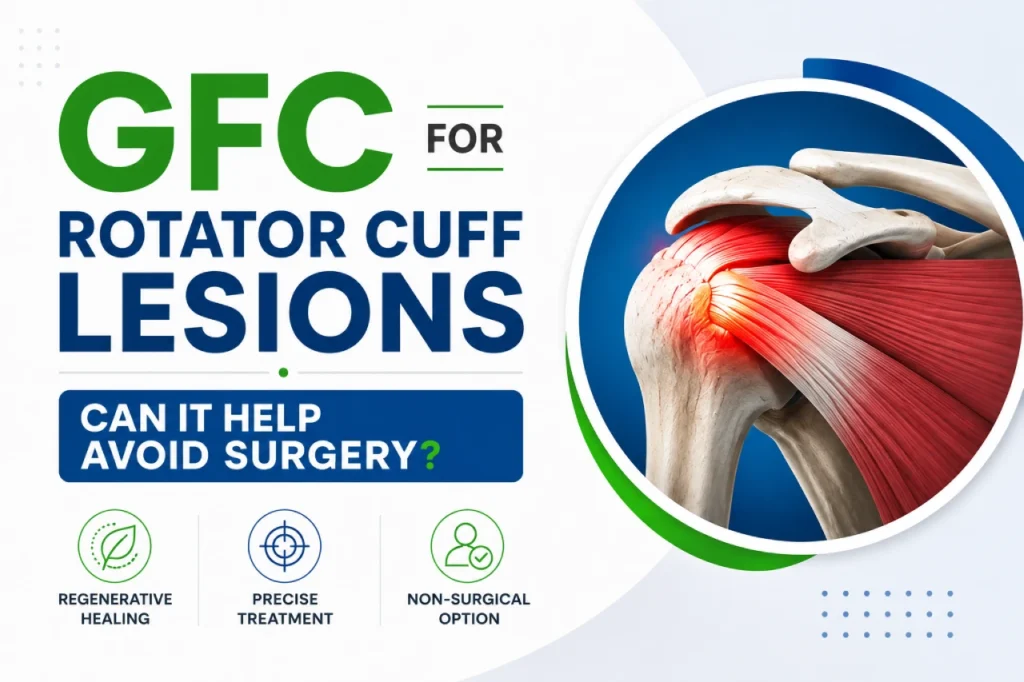
The rotator cuff is made up of four muscles and their tendons around the shoulder. These tendons help the shoulder remain stable while the arm moves. They can become irritated, worn or damaged over time. Sometimes the problem follows an injury, while in other cases there is no single event that the patient can remember.
When a rotator cuff lesion has been present for a long time, the obvious question is often: “Do I really need surgery?”
Not necessarily.
The answer depends on what has happened to the tendon and how badly the shoulder is affected. Physiotherapy, strengthening exercises, medicines and changes in activity are useful for many patients. In some situations, regenerative treatments such as Growth Factor Concentrate (GFC) can also be discussed as part of a non-surgical treatment plan.
What Happens to the Rotator Cuff Over Time?
A rotator cuff lesion is not always a complete tear.
The tendon may simply show degenerative changes. There may be inflammation, tendinopathy or a partial-thickness tear. In more serious cases, the tendon can tear completely.
This distinction makes a big difference when deciding on treatment.
For example, someone with a small partial tear and reasonable shoulder strength may have several non-surgical options. A patient with a large traumatic tear and marked weakness may need a very different approach.
Rotator cuff problems can develop in people who regularly use their arms overhead, including gym-goers, swimmers, racquet-sport players and people whose work involves repeated shoulder movements. Age-related changes in tendon quality can also contribute.
What Does a Long-Standing Rotator Cuff Lesion Feel Like?
There is no single symptom that confirms a rotator cuff lesion.
Some patients mainly notice pain. Others complain more about weakness or restricted movement.
Typical complaints include:
- Pain when lifting the arm
- Discomfort while reaching overhead
- Pain at night
- Trouble sleeping on the affected side
- Weakness during lifting
- Difficulty reaching behind the back
- Pain during gym exercises
- Repeated shoulder pain after physical activity
A person may also notice that the shoulder feels better for a few days and then becomes painful again after increased activity. This can lead to a cycle of resting, feeling better, returning to normal activity and developing symptoms again.
If this has been happening for months, it is worth finding out why.
Why Does an Old Rotator Cuff Problem Sometimes Persist?
Tendons are not particularly well supplied with blood compared with some other tissues. Chronic tendon degeneration can therefore be difficult to manage.
That does not mean that the tendon cannot improve. It means that simply waiting for the pain to disappear may not always be enough.
Physiotherapy remains an important part of treatment. Strengthening the muscles around the shoulder, improving movement and reducing activities that repeatedly aggravate the tendon can make a substantial difference.
But what if the symptoms continue?
This is where the discussion can move towards other treatment options.
What Is GFC?
GFC stands for Growth Factor Concentrate.
The treatment is prepared using the patient’s own blood. After processing, a concentrate containing growth factors is obtained and used for the intended treatment area.
The reason for using GFC is to support the body’s own biological response around the affected tissue.
It is important, however, to keep the treatment in perspective. GFC is not a magic injection and it is not suitable for every shoulder problem. Whether it makes sense depends on the actual tendon lesion, the patient’s symptoms and the findings on examination and imaging.
In other words, the diagnosis comes before the injection.
Can GFC Be Used for a Long-Standing Rotator Cuff Lesion?
In the right situation, it may be an option.
For example, a patient with persistent symptoms related to tendon degeneration or a suitable partial-thickness lesion may want to explore non-surgical treatment before moving towards surgery.
The purpose of GFC is to provide a biological treatment aimed at supporting the local healing environment. It is generally considered alongside other measures rather than as a stand-alone solution.
The response is also not identical in every patient. Tendon quality, the extent of the lesion, general health, activity level and rehabilitation all matter.
Why Does the Injection Need to Be Accurate?
This is an area that is sometimes overlooked.
The shoulder contains several tendons and other structures within a relatively small space. If the treatment is intended for a particular tendon or target area, simply injecting somewhere around the shoulder is not necessarily enough.
At Dr. Sudhir Kapoor’s centre, continuous image intensifier guidance using C-Arm/X-ray can be used during appropriate procedures.
The purpose is straightforward: identify the intended area and place the injection as accurately as possible.
For deeper structures, this can be particularly useful.
Can GFC Help a Patient Avoid Surgery?
Sometimes non-surgical treatment can help a patient avoid or postpone surgery. But it would be wrong to say that GFC can prevent surgery in every rotator cuff tear.
Consider two very different patients.
One has a chronic partial tear, reasonable shoulder movement and manageable weakness. The other has a large full-thickness tear, significant weakness and tendon retraction.
These are not the same problem, even though both may say, “My rotator cuff is torn.”
The second patient may need a surgical opinion. Trying an injection simply to avoid surgery could delay the treatment that is actually needed.
This is why an individual assessment matters.
GFC or PRP: Which One Should You Choose?
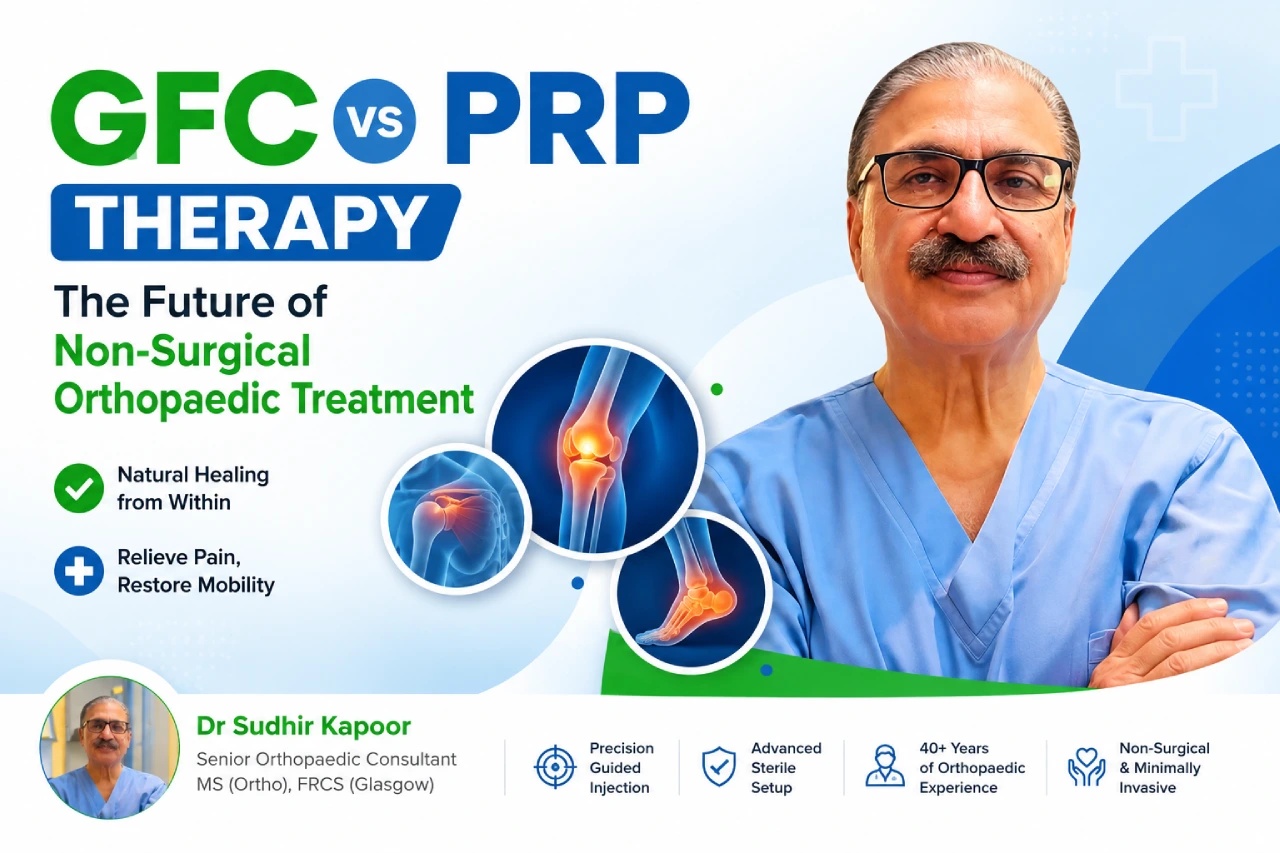
GFC and PRP are often discussed together because both are prepared from the patient’s own blood.
They are not, however, identical.
PRP, or Platelet Rich Plasma, concentrates platelets along with various components found in plasma. GFC is prepared differently, with an emphasis on obtaining a growth-factor concentrate.
PRP has been studied more extensively in rotator cuff conditions. The results are mixed, and there is still ongoing research into which patients are most likely to benefit from different regenerative approaches.
So there is no sensible “one injection is always better” answer.
The choice should follow the diagnosis.
When Might GFC Be Discussed?
A doctor may discuss GFC when a patient has persistent symptoms associated with a suitable tendon problem and wants to consider a non-surgical approach.
It may be relevant in some cases of:
- Chronic rotator cuff tendinopathy
- Tendon degeneration
- Selected partial-thickness lesions
- Persistent tendon-related shoulder pain
It is not automatically appropriate simply because an MRI shows a rotator cuff abnormality.
The scan needs to be interpreted alongside the patient’s symptoms and physical examination.
When Is Surgery More Likely to Be Needed?
There are situations where an injection is unlikely to be the right answer.
A large full-thickness tear, substantial weakness, significant tendon retraction or an acute traumatic tear may require surgical assessment. Persistent loss of shoulder function despite appropriate non-surgical treatment is another reason to seek a surgical opinion.
The goal is not to avoid surgery at any cost.
The goal is to avoid unnecessary surgery while also not delaying necessary surgery.
That distinction is important when treating a long-standing rotator cuff lesion.
Why Experience Matters in Regenerative Treatment
Regenerative medicine is not simply about having an injection.
Before deciding on GFC, the doctor needs to establish what is causing the shoulder pain and whether the tendon is actually the source of the symptoms.
Dr. Sudhir Kapoor has more than 40 years of experience in orthopaedics. His approach is to first assess the underlying shoulder problem and then decide whether a non-surgical treatment such as GFC has a reasonable role.
The procedure itself is only one part of treatment. Rehabilitation and appropriate activity after treatment also matter.
Final Thoughts
Living with shoulder pain for months can be frustrating, particularly when medicines or physiotherapy have not provided lasting relief.
For some patients with long-standing rotator cuff problems, GFC may be worth discussing as a non-surgical treatment option. It is not appropriate for every lesion, and it cannot be presented as a guaranteed alternative to surgery.
The starting point should always be an accurate diagnosis.
If you have persistent shoulder pain, weakness or a known rotator cuff lesion, an orthopaedic assessment can help determine whether continued conservative treatment, GFC, another injection-based treatment or surgery is the better route for you.
FAQs
Can GFC repair a rotator cuff tear?
GFC may be considered for selected tendon problems, but it should not be described as a guaranteed method of repairing every rotator cuff tear. Large or complete tears may require surgical treatment.
Can GFC help me avoid rotator cuff surgery?
It may help some appropriately selected patients continue with non-surgical treatment. Whether surgery can be avoided depends on the size and type of tear, shoulder strength, symptoms and imaging findings.
Is GFC better than PRP for a rotator cuff lesion?
There is no universal answer. GFC and PRP are different preparations, and the evidence for regenerative treatments in rotator cuff conditions is still evolving.
Does GFC injection hurt?
The procedure involves an injection, so some temporary discomfort can occur. Mild soreness around the treated area after the procedure is also possible.
Why use C-Arm guidance for GFC?
C-Arm/X-ray guidance can help the doctor identify the intended anatomical area and improve injection accuracy, particularly when treating deeper structures.
How long can a rotator cuff lesion last?
It varies considerably. Some tendon problems improve with appropriate rehabilitation, while chronic degeneration or a significant tear can continue to cause symptoms without suitable treatment.
Should everyone with a rotator cuff lesion have GFC?
No. GFC is only one possible treatment. The appropriate approach depends on the patient’s symptoms, examination findings, imaging and the nature of the tendon problem.