
Joint pain used to leave most people with two choices: manage it with painkillers or go for surgery. Neither is ideal, especially for someone who is still active, working, or simply not ready for an operation. Over the last decade, regenerative treatments have changed that conversation significantly. PRP and GFC therapy are now being used by orthopaedic specialists worldwide to treat knee arthritis, tendon injuries, shoulder pain, and sports-related conditions – without surgery, without hospitalisation, and without long recovery periods. This page explains how both treatments work, where they differ, and which one may be more suitable for your condition.
For ages, the options were pretty limited: painkillers, physiotherapy, countless steroid shots, or surgery. But, modern orthopaedics is changing rapidly, and one of the biggest advancements is regenerative medicine. This approach harnesses the body’s natural healing power to fix damaged tissues. Among the cutting-edge regenerative treatments currently available are:
- PRP (Platelet Rich Plasma) Therapy
- GFC (Growth Factor Concentrate) Therapy
These treatments are already helping many people manage chronic pain and inflammation without ever going under the knife.
What is PRP Therapy?
PRP stands for Platelet Rich Plasma. Here’s how it works: a small sample of your blood is taken and then processed to concentrate your platelets. These platelets are packed with natural growth factors that help with:
- Reduce inflammation
- Promoting tissue repair
- Enhance healing response
- Support recovery of damaged tendons and joints
PRP has become a widely used treatment in orthopaedics and sports medicine for various chronic pain conditions.
What is GFC Therapy?
GFC (Growth Factor Concentrate) is considered a more advanced form of regenerative treatment. Instead of injecting concentrated platelets, GFC isolates and delivers purified growth factors responsible for tissue healing and regeneration.
This process may provide:
- Enhanced biological healing response
- More targeted regenerative action
- Reduced inflammatory reaction
- Improved tissue recovery
GFC is commonly used for:
- Knee arthritis
- Shoulder injuries
- Tennis elbow
- Heel pain
- Tendon injuries
- Ligament strains
- Sports injuries
GFC vs PRP: What’s the Difference?
| Feature | PRP Therapy | GFC Therapy |
|---|---|---|
| What is used | Concentrated platelets in plasma | Purified activated growth factors only |
| How it is processed | Single centrifugation of blood | Multi-step activation and extraction |
| Inflammatory content | May contain some | Significantly reduced |
| Best suited for | Early arthritis, tendon injuries | Moderate arthritis, chronic degeneration |
| Regenerative precision | Moderate | Higher |
| Sessions typically needed | 2 to 3 | 1 to 2 |
| Procedure setting | Day care | Day care |
| Derived from | Patient’s own blood | Patient’s own blood |
The ideal treatment depends on factors such as the patient’s age, activity level, severity of injury, and overall orthopaedic evaluation.
Why Precision Matters in Regenerative Injections
A regenerative injection is only as effective as its placement. Many patients who report poor results from PRP or GFC therapy elsewhere have not had imaging guidance used during the procedure. Without it, even the right treatment can miss the exact area that needs it.
Even a small deviation from the targeted area can affect outcomes significantly.
This is why advanced orthopaedic centres use Continuous Image Intensifier Guidance (C-Arm/X-Ray) to ensure accurate delivery of regenerative injections directly into the damaged tissue.
This is especially important for:
- Knee joints
- Shoulder tendons
- Hip conditions
- Foot and ankle disorders
- Deep tendon injuries
Accurate placement improves precision, safety, effectiveness, and long-term results.
Why Patients Choose Dr. Sudhir Kapoor for GFC & PRP Therapy
Successful regenerative treatment depends on more than just the injection itself.
Important factors include:
- Accurate diagnosis
- Orthopaedic expertise
- Injection precision
- Sterility standards
- Advanced technology
Advanced In-House Sterile Procedure Setup
Unlike many clinics where injections are performed in standard OPD settings, procedures at Dr. Sudhir Kapoor’s centre are carried out in a dedicated sterile orthopaedic operation theatre.
This setup helps maintain maximum safety standards and minimizes procedural risks.
Continuous Image Intensifier (C-Arm/X-Ray) Guidance
A major advantage of treatment at the centre is the routine use of continuous image intensifier guidance during procedures.
This technology helps ensure that the injection reaches the exact healing area rather than relying on blind or approximate placement.
This is particularly beneficial for:
- Knee pain
- Shoulder injuries
- Tendon degeneration
- Sports injuries
- Foot and ankle conditions
Over 40 Years of Orthopaedic Experience
Regenerative medicine delivers the best outcomes when combined with strong orthopaedic expertise.
With more than four decades of experience, Dr. Sudhir Kapoor focuses on identifying the root cause of pain before recommending treatment.
This approach helps patients avoid:
- Unnecessary procedures
- Repeated ineffective injections
- Delayed treatment
- Misdiagnosis
Conditions Commonly Treated with GFC & PRP Therapy
Knee Osteoarthritis
Patients with early to moderate arthritis experiencing pain, stiffness, swelling, or difficulty walking may benefit from regenerative therapy aimed at improving function and reducing discomfort.
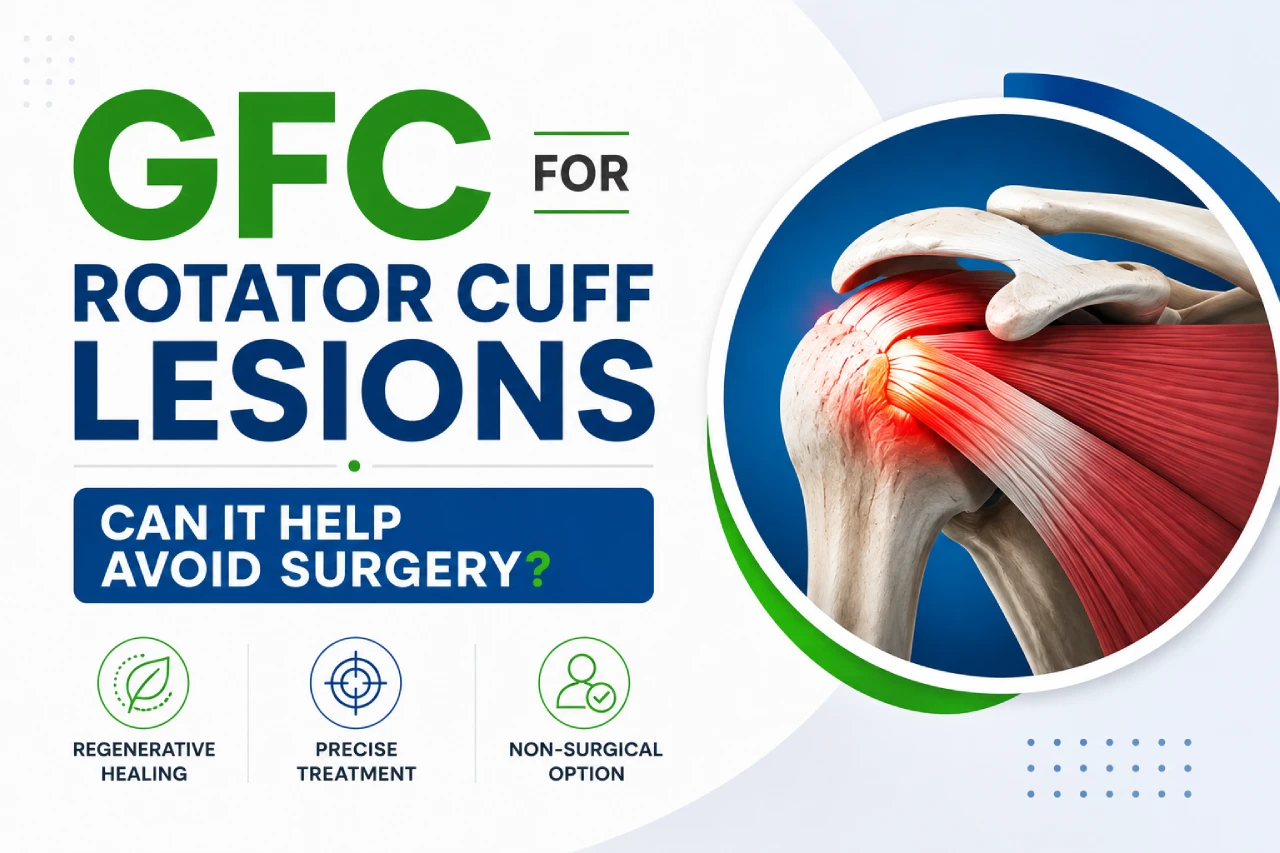
Shoulder Pain and Rotator Cuff Problems
PRP and GFC therapy may be considered for:
- Rotator cuff inflammation
- Tendinitis
- Partial tendon injuries
- Frozen shoulder
Tennis Elbow and Golfer’s Elbow
Chronic elbow pain caused by repetitive strain often responds poorly to medication alone. Regenerative injections focus on supporting tissue healing rather than only suppressing symptoms.
Plantar Fasciitis and Heel Pain
Persistent heel pain can significantly affect daily activities. Regenerative therapy may help reduce inflammation and support healing in difficult cases.
Are GFC and PRP Better Than Steroid Injections?
Steroid injections work by suppressing inflammation and they do provide relief, but usually for a limited period. With repeated use over months or years, steroids can actually weaken the surrounding tissue and cartilage, which is the opposite of what a joint already under stress needs. PRP and GFC take a different approach. Instead of masking the problem, they work by stimulating the body’s own repair process. For patients who have been cycling through steroid shots without lasting improvement, regenerative therapy is often the logical next step.
Benefits of Regenerative Orthopaedic Therapy
Patients often choose PRP and GFC because they are:
- Minimally invasive
- Non-surgical
- Day-care procedures
- Derived from the patient’s own blood
- Associated with minimal downtime
- Suitable for active lifestyles
- Designed to promote natural healing
Who Can Benefit from GFC or PRP Therapy?
You may be a suitable candidate if you:
- Have chronic knee or shoulder pain
- Wish to avoid surgery
- Suffer from sports injuries
- Have tendon or ligament problems
- Have not achieved lasting relief with medications
- Are in the early stages of arthritis
- Prefer minimally invasive treatment options
The Future of Orthopaedics is Regenerative
Modern orthopaedics is increasingly focused on preserving joints and enhancing natural healing rather than moving directly to surgery.
Regenerative therapies such as GFC and PRP represent an important advancement in this field. When combined with advanced imaging guidance, sterile procedural environments, and experienced orthopaedic care, these treatments offer a more precise and patient-centred approach to managing chronic joint and tendon pain.
Living with chronic pain can impact mobility, work performance, fitness, and quality of life. Fortunately, regenerative orthopaedic treatments are providing new options for individuals seeking non-surgical solutions.
The success of these therapies depends on proper diagnosis, careful patient selection, accurate injection placement, and experienced orthopaedic expertise.
If you are struggling with persistent joint or tendon pain, exploring advanced regenerative orthopaedic therapy may be worthwhile before considering surgery.
FAQs
Is GFC therapy painful?
The injection itself takes only a few minutes and is done under local anaesthesia at the site. Most patients describe it as a mild pressure. Some soreness may be felt for a day or two after, which is normal and settles on its own.
How long does PRP or GFC treatment take?
The entire process, including blood draw, processing, and injection, is typically completed in under an hour. There is no hospital stay involved. Most patients return to light activity the same day.
Can regenerative therapy avoid surgery?
In early and moderate cases, yes, it can delay or sometimes avoid surgery entirely. In advanced cases where joint damage is severe, regenerative therapy may not be sufficient on its own, but that determination is made after a proper clinical and imaging evaluation.
Why is imaging guidance important during injections?
The joint spaces and tendon attachment points being targeted are small and surrounded by other tissue. Without imaging guidance, there is a real risk of the injection not reaching the exact area. At Dr. Sudhir Kapoor’s centre, C-Arm guidance is used routinely so the treatment goes exactly where it needs to.
Which is better, PRP or GFC?
There is no universal answer. PRP has a longer track record and works well for many tendon and early arthritis cases. GFC is a newer and more refined process that delivers higher concentrations of growth factors with less inflammatory content. For moderate to chronic conditions, GFC is often the preferred option. The final recommendation is always made after evaluating your reports and clinical condition.
Is GFC or PRP therapy available in Delhi?
Yes. Dr. Sudhir Kapoor’s orthopaedic centre in Pitampura, New Delhi offers both GFC and PRP therapy with C-Arm image guidance in a dedicated sterile procedure room.